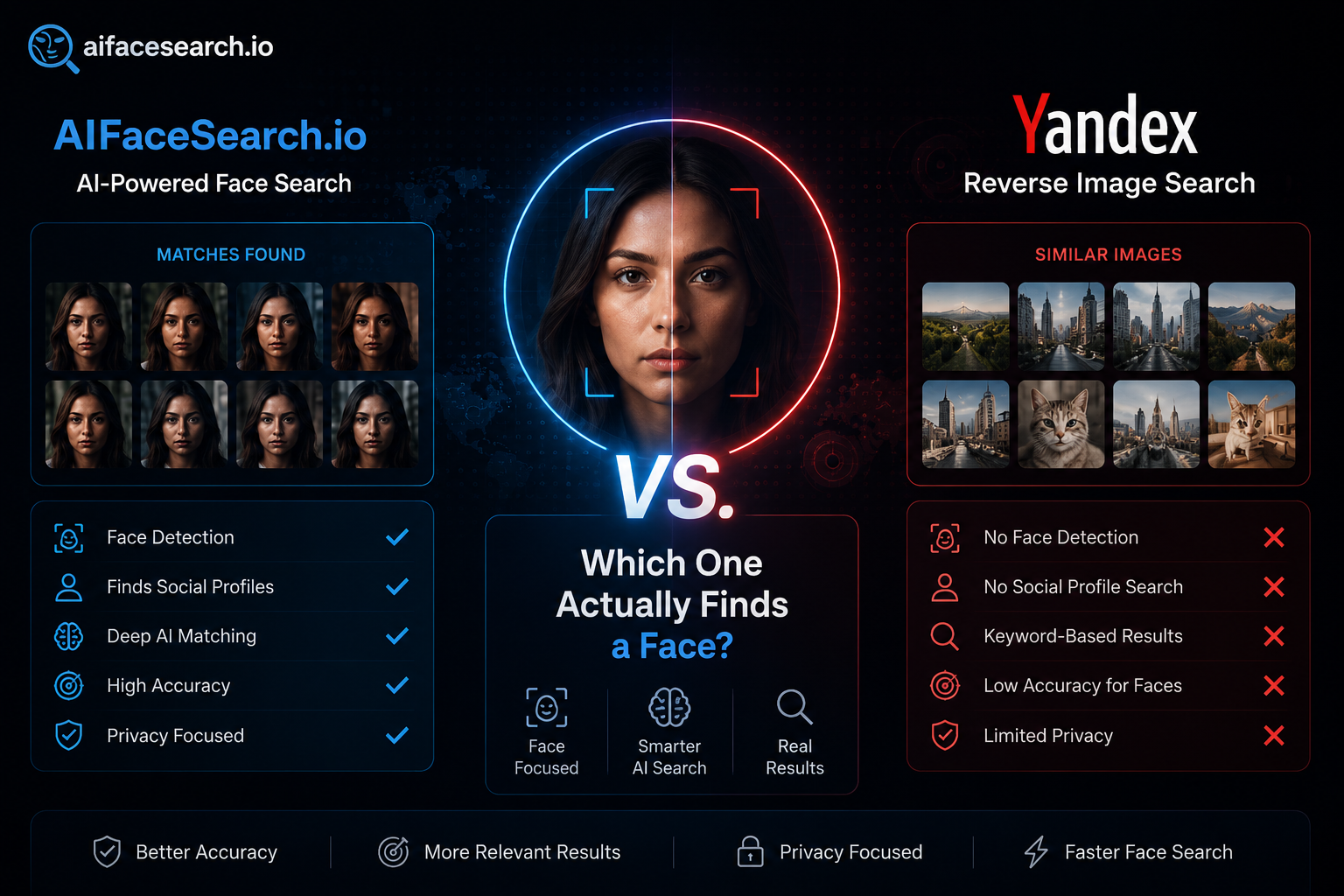
If you’ve spent any time in online safety, OSINT, or catfish-detection communities, you’ve likely heard two names come up again and again: a dedicated face search tool like AIFaceSearch.io, and the surprisingly powerful reverse image search built into Yandex, the Russian search engine. Both can help you trace a photo back to a real identity — but they’re built on fundamentally different technology, and that difference matters a lot depending on what you’re trying to find.
This comparison breaks down how each tool actually works, where each one wins, and which is the better choice for your specific use case.
The Core Difference: Purpose-Built vs. General-Purpose
The single most important thing to understand is that these two tools were designed to solve different problems.
AiFaceSearch is a dedicated facial recognition search engine. It was built specifically to analyze faces — mapping dozens of facial data points such as the distance between the eyes, jawline contour, and cheekbone structure — and match that biometric pattern across different photos of the same person.
Yandex, on the other hand, is a general-purpose visual search engine. It wasn’t designed as a face recognition product at all; it’s built to find visually similar images of anything — objects, landmarks, products, and yes, faces. Its face-matching ability is a well-known side effect of how thoroughly its algorithms analyze visual composition, not its primary design goal.
That distinction shapes almost everything else in this comparison.
How Each Tool Handles Facial Matching
AIFaceSearch.io
AIFaceSearch.io‘s entire product is centered on the face. Its search engine analyzes facial geometry rather than general image composition, which means it’s built to recognize the same person even when the photo itself has changed significantly — different background, different lighting, a different haircut, or years between photos. Alongside its core face search, the platform also offers related tools such as face match (comparing two specific photos), social profile lookup, celebrity lookalike search, and an AI-generated image detector, all built around the same facial-analysis engine.
Yandex Reverse Image Search
Yandex approaches facial matching as one part of a much broader visual similarity system. Its algorithm weighs facial structure alongside background, clothing, color palette, and overall composition. This makes it very effective at finding exact reposts of a photo or catching a stolen profile picture that’s been reused elsewhere — but because it isn’t purely identity-focused, it can also return “lookalikes” who simply share a similar pose, lighting setup, or facial framing rather than being the same actual person.
Feature-by-Feature Comparison
| Feature | AIFaceSearch.io | Yandex Reverse Image Search |
|---|---|---|
| Primary purpose | Dedicated face recognition search | General-purpose visual/image search |
| Matching method | Facial geometry and biometric mapping | Mixed visual similarity (face, background, color, composition) |
| Best at | Finding the same person across unrelated photos | Finding exact reposts and stolen images |
| Additional tools | Face match, social lookup, celebrity lookalike, AI image detector, batch processing | Built-in OCR (text-in-image detection), object/landmark search |
| Regional index strength | Broad public web, social platforms, and news | Especially strong on Russian, Eastern European, and Asian web content |
| Data privacy claims | States it does not store uploaded search photos and uses end-to-end encryption | Images are processed through Yandex’s servers, based in Russia — a consideration for sensitive searches |
| Cost model | Freemium with paid tiers | Free to use |
| Account required | Yes, for full features | No |
When AIFaceSearch.io Is the Better Choice
- You’re trying to catch a catfish or verify a dating profile. Because it’s built to recognize the same person even across very different photos, it’s well-suited to situations where you only have one or two images to work with.
- You want an all-in-one identity verification workflow. Features like batch processing (searching multiple images at once) and social profile lookup are aimed squarely at people doing verification or investigative work, not casual browsing.
- Data handling is a concern. A platform built specifically around face search will typically be more explicit about how it handles biometric data, which matters if you’re dealing with sensitive searches.
- You want to check for AI-generated or manipulated images. A built-in AI image detector is useful for spotting deepfakes or synthetic profile photos, a growing problem general search engines aren’t designed to catch.
When Yandex Is the Better Choice
- You’re trying to find the original source of a photo. Yandex’s strength in indexing reposted, scraped, and mirrored content makes it excellent for tracing exactly where an image first appeared online.
- The photo may be linked to Eastern European, Russian, or Asian websites. Yandex’s index coverage in these regions is considerably deeper than most Western search engines, which matters if a scam or stolen photo originates from those areas.
- You need built-in text recognition. Yandex can detect and extract text embedded in an image — a street sign, a name tag, a watermark — which is useful for context clues a pure face search won’t surface.
- You want a completely free option with no account. Yandex requires no sign-up and imposes no obvious search limits for casual use.
The Honest Limitation of Each Tool
No single tool tells the whole story. Yandex can occasionally surface people who merely resemble your target rather than confirming an actual match, since its algorithm isn’t purely identity-based. AIFaceSearch.io, meanwhile, depends on the target person having some existing public photo footprint — if someone has almost no online presence, or the only comparison photo is AI-generated with no real-world matches, a dedicated face search may return limited results.
The Smartest Approach: Use Both
Investigators, journalists, and OSINT researchers rarely rely on just one tool, and for good reason. A practical workflow looks like this:
- Start with AIFaceSearch.io to identify potential facial matches across different photos and platforms, especially if you’re working from a single image.
- Cross-check with Yandex to trace the exact source of the photo and catch any reposted or stolen versions that a face-specific engine might rank lower.
- Compare the results. If both tools point to the same identity, your confidence in that match increases significantly. If they diverge, treat the result with more caution and keep digging.
Final Thoughts
AIFaceSearch.io and Yandex Reverse Image Search aren’t really competitors — they’re complementary tools solving overlapping but distinct problems. AIFaceSearch.io is the sharper instrument when identity is the whole point of the search: catfish detection, dating profile verification, or tracing a person across many different photos. Yandex is the better choice when your priority is tracing an image’s origin, especially across regions and languages other engines under-index. For anyone serious about photo-based verification, the winning strategy isn’t choosing one over the other — it’s using both together.
Leave a Reply