Category: Facial Recognition

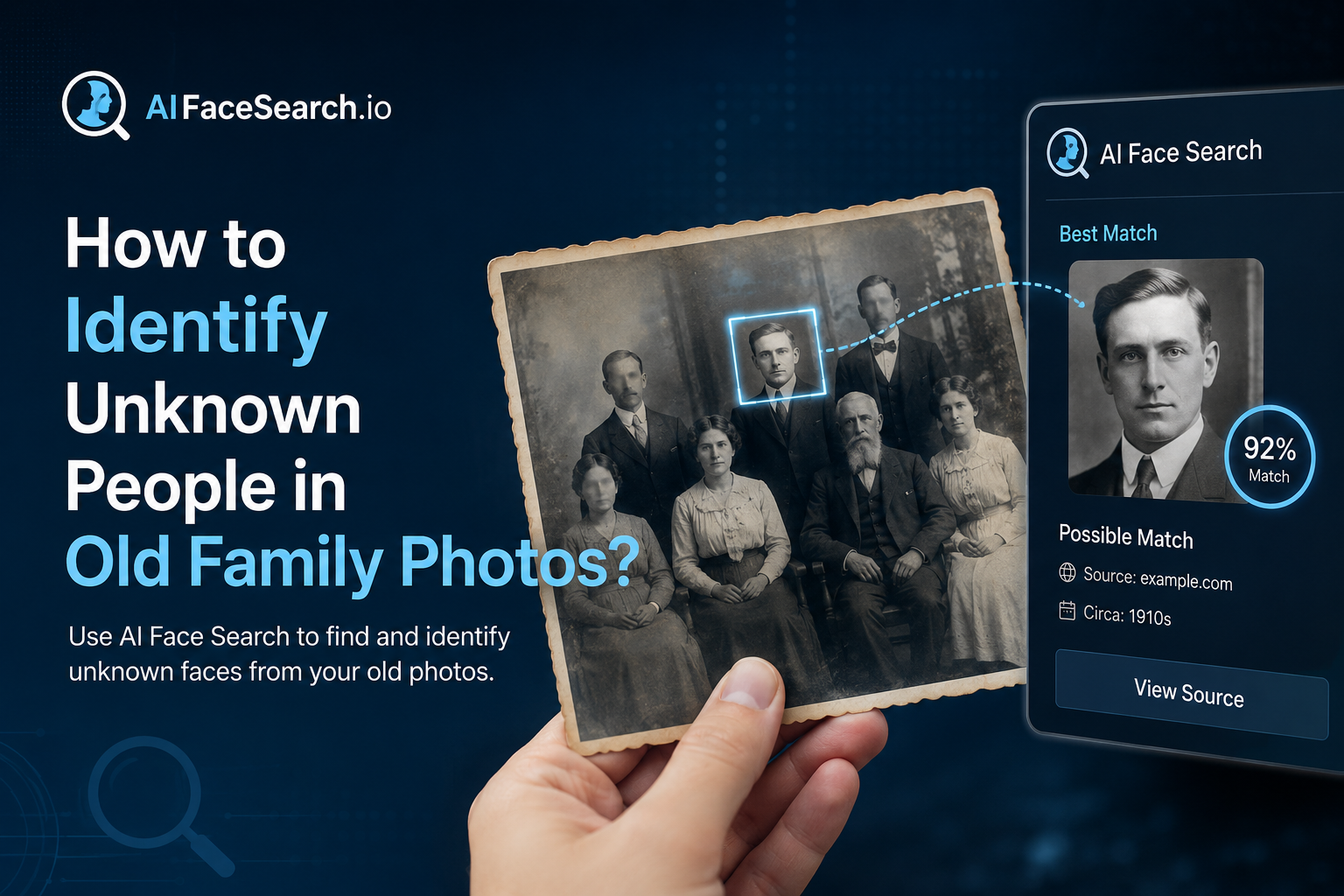
  • How to Identify Unknown People in Old Family Photos?

    How to Identify Unknown People in Old Family Photos?

    That box of unlabeled family photos doesn’t have to stay a mystery. Here’s how facial recognition and a few genealogy research habits can help you put names to faces.

    Almost every family has one: a shoebox, album, or digital folder full of old photographs with no names attached. A wedding portrait from the 1940s. A group photo at a reunion where only half the faces are familiar. A childhood picture of a grandparent, unrecognizable except for a family resemblance you can’t quite place. For most of history, solving these mysteries meant relying entirely on living relatives’ memory — and once that generation is gone, so is the context. Facial recognition technology has become a genuinely useful new tool for this specific kind of research, one that major genealogy platforms have invested in heavily over the past few years.

    Why This Has Become Easier in the Last Few Years?

    At RootsTech, the world’s largest family history conference, recent sessions have focused heavily on how artificial intelligence and facial recognition are changing photo-based genealogy research. Major platforms including Ancestry and FamilySearch have built facial recognition directly into their tools, allowing users to scan a photo collection and receive suggested matches against other photos already tagged with names in a family tree. This is a meaningful shift from just a few years ago, when identifying a face in an old photo depended almost entirely on someone in the family remembering it correctly.

    From Manual Comparison to Structural Matching

    Older approaches to this problem — squinting at two photos side by side, trying to judge whether a nose or jawline matches — are subjective and unreliable, especially across large age gaps. Modern facial recognition tools instead map the geometric relationships between facial features (the distance between the eyes, the shape of the jaw, the position of the cheekbones) and compare that structure across photos, which tends to hold up better across decades of aging than a purely visual comparison does.

    Step-by-Step: Identifying Faces in Your Old Photos

    1. Digitize and Prepare Your Collection First

    Before running any kind of facial recognition search, physical photos need to be scanned at a reasonably high resolution — genealogy specialists commonly recommend a minimum of 600 DPI to preserve enough facial detail for reliable analysis. Handle original prints carefully (cotton gloves are a common recommendation to avoid oil and dirt damage) since many of these images are irreplaceable.

    2. Start With Photos You Can Already Identify

    Facial recognition tools work by comparison, so they need a starting reference point. Begin by tagging photos of relatives whose identities you’re already confident about — the more tagged, known photos of a person you have across different ages, the more reliable the software becomes at recognizing that same person in an unlabeled photo, including much older or younger versions of their face.

    3. Run Reverse and Structural Face Comparisons on the Unknowns

    Once you have a base of known, tagged faces, the unidentified photos can be checked against that library. Several tools approach this differently:

    • Family-tree-integrated tools (like those built into major genealogy platforms) suggest matches directly from your own tagged photo collection and cross-reference against your existing family tree data.
    • Cross-user matching tools allow you to opt in to compare your unidentified faces against photos shared by other genealogists — useful when a mystery relative might appear in a different branch of the family’s photo collection, one you don’t have access to.
    • General-purpose face and reverse image search tools can help in a different way: checking whether a specific photo (or the person in it) appears anywhere else online, which is particularly useful for photos that may have been published historically — in a newspaper, a yearbook, or a public archive — even if no living relative has ever seen that specific print.

    4. Cross-Reference With Non-Photographic Clues

    Facial recognition works best as one signal among several, not a standalone answer. Genealogists specializing in old photo identification recommend combining any facial match with:

    • Clothing and fashion dating. Clothing styles, hairstyles, and photographic formats (tintype, cabinet card, Polaroid, etc.) can narrow down a rough time period.
    • Photographer’s studio marks. Many older prints include a studio name or location stamped on the back or border, which can be cross-referenced against business records to narrow down when and where a photo was taken.
    • Family tree context. If facial recognition suggests two photos show the same person, check whether the estimated ages and time period are even plausible given what you know about that relative’s life.

    5. Treat Software Suggestions as Leads, Not Verdicts

    Every genealogist who has worked extensively with these tools makes the same point: manage your expectations. AI face match performs best on high-quality, front-facing photos and becomes noticeably less reliable with blurry images, extreme angles, or very low-resolution scans. A suggested match is a strong lead worth investigating further — checking against other records, asking older relatives, cross-referencing dates — not a final, unquestionable identification.

    What to Do Once You’ve Identified a Face

    Document Your Sources

    When you do confirm an identification — whether through facial recognition, a relative’s memory, or supporting records — write down how you reached that conclusion. Future researchers in your family (including future you) will want to know whether an ID is a confirmed fact or an educated guess.

    Build a Simple Organization System

    Genealogy researchers who’ve been through large unlabeled photo collections consistently recommend setting up a naming or tagging system as you go, rather than waiting until the end. Once photos are re-boxed or re-filed without names attached, you’re back to square one — which, for many people, is exactly how they ended up with an unlabeled collection in the first place.

    Share Findings With Extended Family

    Photo identification projects often benefit enormously from wider family input. A cousin or distant relative may have a labeled version of the exact same photo, additional context about the event pictured, or a stronger memory of a specific relative’s appearance at a particular age. Cross-user genealogy photo tools exist specifically to make this kind of extended-family collaboration easier, even among relatives who’ve never met.

    A Realistic Set of Expectations

    Facial recognition has meaningfully lowered the barrier to solving old family photo mysteries, but it isn’t magic. It performs best when you already have a reasonably well-documented family tree and a decent number of confidently identified reference photos to compare against. For very old, low-quality, or heavily damaged images — and for people who left little to no photographic record at all — some mysteries will likely remain mysteries. Even so, for the enormous number of “who is this?” photos sitting in family collections worldwide, this technology has turned what used to be dead ends into genuinely solvable research questions.
  • Face Recognition in Policing: Benefits and Risks

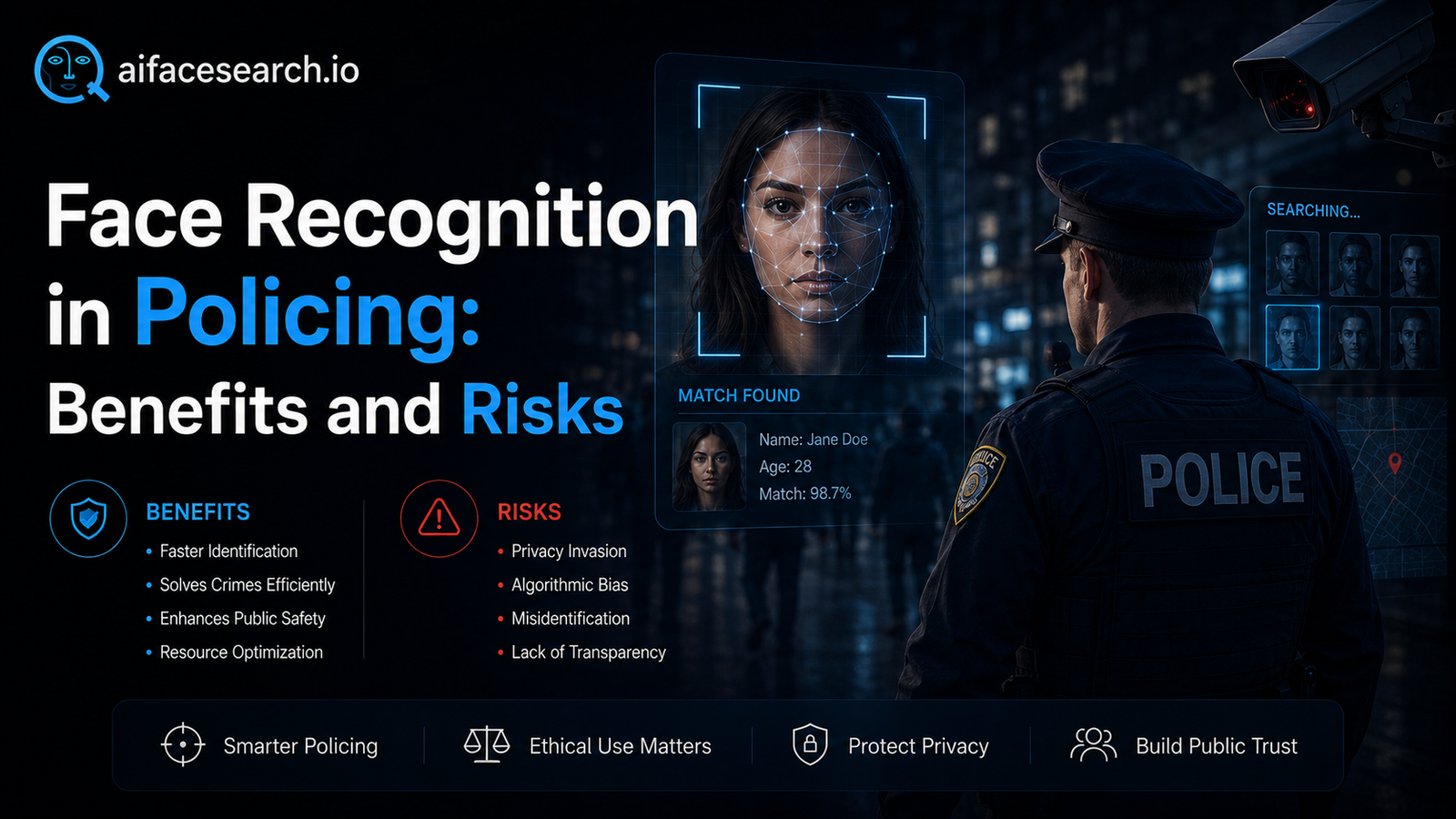
    Face Recognition in Policing: Benefits and Risks

    Nowhere is the facial-recognition debate more intense than in law enforcement — because the stakes, on both sides, are at their highest.

    How police use facial recognition

    Police use of the technology generally falls into a few categories:

    • Retrospective search: comparing an image of an unknown suspect (from CCTV, a doorbell camera, or social media) against a database of mugshots or other reference images to generate investigative leads.
    • Live facial recognition (LFR): mounted cameras scanning faces of passers-by in real time and comparing them against a “watchlist” of wanted individuals. If there is no match, the images are deleted; if there is a match, nearby officers are alerted.
    • Operator-initiated facial recognition (OIFR): an officer uses a mobile app to check the identity of someone who cannot or will not identify themselves.

    Adoption is accelerating. In the UK — one of the most active deployers — live facial recognition was used by 13 of 43 police forces as of early 2026, with the Home Office announcing plans to expand the technology nationally, including the purchase of dozens of new LFR vans aimed at violent and sexual offenders. The first permanent LFR cameras were installed in South London in late 2025.

    The benefits

    Supporters point to concrete public-safety gains:

    • Finding missing people. This is consistently the most publicly supported use. In U.S. survey research, roughly 78% of people believe facial recognition would help police find more missing persons.
    • Solving crimes faster. The technology can rapidly narrow a suspect pool that would take human investigators days or weeks to work through. Around 74% of Americans surveyed expect it to help solve crimes more quickly.
    • Exonerating the innocent. The same comparison that implicates a suspect can also rule one out, clearing wrongly accused people.
    • Identifying suspects who refuse to cooperate. OIFR can resolve identity on the spot rather than relying on detention.

    Public opinion is broadly — if cautiously — supportive. UK Home Office research in 2025 found 64% of the public supported police use of the technology, with only about 11% opposed. Independent studies have reached similar conclusions.

    The risks

    The concerns, however, are serious and well-documented:

    • Accuracy and bias. Facial recognition is not infallible. Error rates have historically been higher for women and people with darker skin tones, raising the risk that the technology compounds existing racial disparities in policing. Some empirical studies have linked FRT use to increased racial disparities in arrests.
    • False arrests. When a match is treated as proof rather than a lead, the consequences are severe — there have been documented cases of people wrongly arrested based on a bad match.
    • Mass surveillance and the chilling effect. Live facial recognition scans everyone who walks past, not just suspects. Around 69% of Americans believe widespread police use would let authorities track everyone’s location at all times — a capability that can deter lawful protest and free assembly.
    • Disproportionate targeting. About two-thirds of Americans worry the technology would be deployed more heavily in Black and Hispanic neighborhoods.
    • Weak oversight. Critics — including, in the UK, the Equality and Human Rights Commission — argue that the law has not kept pace, leaving a “patchwork” of rules rather than a clear framework.

    Where regulation is heading

    Governments are scrambling to catch up. The UK ran a public consultation through early 2026 aimed at building a single, coherent legal framework to replace the current patchwork. Globally, regulatory approaches vary enormously — from near-bans in some jurisdictions to permissive frameworks in others.

    Among experts, a rough consensus on best practice has emerged, even where the law has not. The most widely cited principles include:

    • Use facial recognition only to generate investigative leads — never as the sole basis for an arrest.
    • Document and audit every use.
    • Train officers not just in how to use the tools, but when and why.
    • Appoint internal coordinators to oversee compliance.
    • Be transparent with the public about when and where the technology is deployed.

    The underlying message from researchers is sobering: the benefits of police facial recognition are often assumed rather than rigorously demonstrated, while the risks are well-theorized but under-examined in real-world practice. The technology is not a silver bullet, and treating it like one is where the danger lies.

    Frequently Asked Questions

    Is AI face search legal? The tools themselves operate legally in many places, but how you use them matters. Using face search to stalk, harass, or identify someone without consent can violate privacy, harassment, or data-protection laws depending on your jurisdiction. Several tools also offer opt-out processes for people who do not want their faces indexed.

    Can I remove my face from these search engines? Some face search services offer an opt-out request process, though it usually requires identity verification and only removes results from that engine — not from the original websites hosting the photos.

    Do stores have to tell me they use facial recognition?

    It depends on the jurisdiction. Some states and countries require notice through signage or disclosures; others do not have explicit requirements. Best practice — and increasingly, legal expectation — is clear posted signage at entrances.

    Is facial recognition accurate?

    Top algorithms tested by bodies like the U.S. National Institute of Standards and Technology can exceed 99% accuracy under ideal conditions. Real-world conditions — poor lighting, angles, low-resolution cameras — degrade performance, and accuracy has historically varied across demographic groups. That is exactly why experts insist it be used as one input among many, not as definitive proof.

    What’s the difference between facial recognition and facial detection?

    Facial detection simply identifies that a face is present in an image (the box your phone camera draws). Facial recognition goes further, matching that face to a specific identity.

    The Bottom Line

    Face recognition technology is neither a miracle nor a menace — it is a powerful tool whose value depends entirely on how, where, and by whom it is used.

    For consumers, understanding the difference between a reverse image search and a true face search is the first step toward protecting your own digital footprint. For retailers, the technology offers a real defense against an escalating theft crisis — but only if deployed with rigorous attention to privacy law and accuracy. And for the public debate around policing, the central challenge is making sure the safeguards, oversight, and evidence base catch up to a technology that is already being rolled out at scale.

    The questions are no longer hypothetical. The cameras are already on.